My recent activities got me thinking - should we be called researchers or journalists?
I just corrected proofs for one of my papers for Applied Thermal Engineering, finished writing an invited paper for the same journal (during my vacation, I might add) and have to start writing another invited paper for Energy - The International Journal. All this leaves me with very little time to work towards my paper for the biggest conference in my area PSE/ESCAPE 2006, which is due in Nov.
I am spending way too much time disseminating the results of our research rather than producing more. Need to find a balance!!!!!
Saturday, September 24, 2005


Friday, September 23, 2005
Presenting Ananya
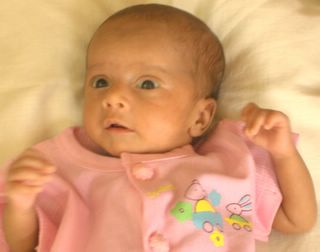
KuttiMe is now officially called Ananya (or Ananya R. Raman as her passport says).
Ananya - a name suggested by my cousin- is the very essence of Advaita. We were initially planning on calling her Jyotsna (moonlight) - a subtle reference to the fact that she was concieved in November when the moon rules in Norway. As I was filling out her Birth Certificate, Arthi changed her mind and we then decided to go with Ananya.
The Gods know her as Sri Jayalakshmi (her religious name) and my parents like to call her Anagha (without blemish).
To Arthi and me, she will always be KuttiMe.
Ananya - a name suggested by my cousin- is the very essence of Advaita. We were initially planning on calling her Jyotsna (moonlight) - a subtle reference to the fact that she was concieved in November when the moon rules in Norway. As I was filling out her Birth Certificate, Arthi changed her mind and we then decided to go with Ananya.
The Gods know her as Sri Jayalakshmi (her religious name) and my parents like to call her Anagha (without blemish).
To Arthi and me, she will always be KuttiMe.
Wednesday, August 10, 2005
Reverse Osmosis
Apparently, Indian summer is cooler than Wall Street. This article in the NYTimes reports many MBA students from top schools in the US are choosing internships opportunities in India.
In less than 12 hrs..
I leave for Chennai, India. It has been a long wait from the 18th of July till now and can't wait to see Kuttime and A. Really, really excited, I am.
I was feeling fatherish (if that is a word) a couple of days after July 18th and then it dissapeared - only to reappear now, as I am preparing for my trip. Guess it will truly sink in when I hold her in my arms.
I will be in Chennai till the 15th of Sept and then spend a few days in Mumbai before heading back home (yes, Trondheim is home now!!!) on the 18th.
I was feeling fatherish (if that is a word) a couple of days after July 18th and then it dissapeared - only to reappear now, as I am preparing for my trip. Guess it will truly sink in when I hold her in my arms.
I will be in Chennai till the 15th of Sept and then spend a few days in Mumbai before heading back home (yes, Trondheim is home now!!!) on the 18th.
Friday, August 05, 2005
What is you question?
 Yes, what is your question to the collective wisdom of the world?
Dropping Knowledge gives you this chance.
Dropping Knowledge describes itself as an eductaional resource that connects people around the globe seeking to exchange ideas and solutions to the most pressing questions of our day.
On their website they say
dropping knowlege means dropping the assumption that we know all the answers. It means questioning the conventional wisdom. It means figuring out which questions are the most important to ask, sharing answers and then challenging those answers. We call the proctice of asking questions and sharing wisdom, dropping knowledge.
599 questions have been asked thus far. All these questions (and many more yet to be asked) will be combined to form a social issue framework. A pool of 1000 potential participants will form a web-based source of research, which will be used to narrow the answers by 112 global leaders. An audio-visual interactive archive online will be built for these answers that will encourage a global discussion.
The scale of the projec is very impressive. Wether it will succeed or not in its ultimate goal of generating wisdom...well, as always, only time will tell.
Go on, ask your question.
Link via WorldChanging.
Thursday, August 04, 2005
Earlier Marxists - now Jihadis
David Brooks in his Op-ed column of NY Times, Trading Cricket for Jihad, tells us
In his book "Globalized Islam," the French scholar Olivier Roy points out that today's jihadists have a lot in common with the left-wing extremists of the 1930's and 1960's. Ideologically, Islamic neofundamentalism occupies the same militant space that was once occupied by Marxism. It draws the same sorts of recruits (educated second-generation immigrants, for example), uses some of the same symbols and vilifies some of the same enemies (imperialism and capitalism).
Roy emphasizes that the jihadists are the products of globalization, and its enemies. They are detached from any specific country or culture, he says, and take up jihad because it attaches them to something. They are generally not politically active before they take up jihad. They are looking to strike a vague blow against the system and so give their lives (and deaths) shape and meaning.
This view is quite interesting and contrary to my view - posted as a comment to Sunil Laxman's post on the same topic.
Seemingly random events
This has been spawned by my earlier post.
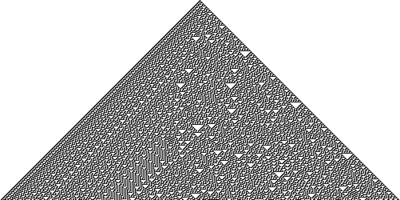
The image above has no fixed pattern (particularly on the right side), and each pixel seems to be unrelated to the next. If each pixel were taken to be an event, the image would represent a collection of events, or more pertinently, a seemingly random collection of events.
Erik Fosnes Hansen in his book Tales of Protection, writes that seemingly disparate and unconnected events in life are connected by a profound something - a something that has not been found or recognized as yet.
The image shown here is a Cellular Automaton of 500 steps from Stephen Wolfram's A New Kind of Science (You can find an earlier post on this here). The image is produced starting with a single black pixel and each subsequent pixel is colored according to Rule 30 in the book. Thus, the seemingly random collection of pixels (or events) is produced using a simple program (Rule 30) and is the something, in this case.
Wolfram, in the introduction to the book, boldly states that this new science, an intellectual revolution, can be used to explain everything. I have only ploughed through 168 pages of this 1197 pages book. Based on what I have read thus far, it is very exciting.
Is this the key to understanding the connection between seemingly disconnected events - such as the probability case?
The image above has no fixed pattern (particularly on the right side), and each pixel seems to be unrelated to the next. If each pixel were taken to be an event, the image would represent a collection of events, or more pertinently, a seemingly random collection of events.
Erik Fosnes Hansen in his book Tales of Protection, writes that seemingly disparate and unconnected events in life are connected by a profound something - a something that has not been found or recognized as yet.
The image shown here is a Cellular Automaton of 500 steps from Stephen Wolfram's A New Kind of Science (You can find an earlier post on this here). The image is produced starting with a single black pixel and each subsequent pixel is colored according to Rule 30 in the book. Thus, the seemingly random collection of pixels (or events) is produced using a simple program (Rule 30) and is the something, in this case.
Wolfram, in the introduction to the book, boldly states that this new science, an intellectual revolution, can be used to explain everything. I have only ploughed through 168 pages of this 1197 pages book. Based on what I have read thus far, it is very exciting.
Is this the key to understanding the connection between seemingly disconnected events - such as the probability case?
Wednesday, August 03, 2005
And now probability
Though not exactly a follow-up on the earlier post, these thoughts came to me when writing it.
In Tales of Protection, Erik Fosnes Hansen bases his fiction on how a collection of seemingly random events are connected by a pattern. As an example:
The probability of heads or tails occurring when a coin is tossed is 0.5. If we get heads 9 times in a row, one would think that there is a greater chance of getting tails the next toss. Yet, the probability is still only 0.5 of getting heads (or tails). Over a large number of tosses, the heads and tails will even out according to its probability. This is fundamental in figuring probability and is call the Law of Large Numbers.
The paradox is that one toss of a coin is unrelated to the next, yet over a large number of tosses the number of heads attain an equilibrium value ( = 0.5 x number of tosses). How is this possible? If the two of us were tossing coins in different parts of the world, would heads turning up for me be affected by what you get?
Is this a self-referencing paradox related to the Gödel's Incompletenesss Theorem? On second thoughts, we probably should leave this much abused theorem be.
In Tales of Protection, Erik Fosnes Hansen bases his fiction on how a collection of seemingly random events are connected by a pattern. As an example:
The probability of heads or tails occurring when a coin is tossed is 0.5. If we get heads 9 times in a row, one would think that there is a greater chance of getting tails the next toss. Yet, the probability is still only 0.5 of getting heads (or tails). Over a large number of tosses, the heads and tails will even out according to its probability. This is fundamental in figuring probability and is call the Law of Large Numbers.
The paradox is that one toss of a coin is unrelated to the next, yet over a large number of tosses the number of heads attain an equilibrium value ( = 0.5 x number of tosses). How is this possible? If the two of us were tossing coins in different parts of the world, would heads turning up for me be affected by what you get?
Is this a self-referencing paradox related to the Gödel's Incompletenesss Theorem? On second thoughts, we probably should leave this much abused theorem be.
Statistics as anecdotal thinking...
I am reviewing a paper where the authors prop up their not-on-strong-theoretical-ground claims with loads of statistics. I couldn't but help recall
Census, I feel, is a practical branch of statistics mainly because its sample is the entire population. Analyzing the census data could illuminate what already exists, but when one tries to use this data for prediction, it is no longer practical. Similar is the case with polls. How scientific are scientifically conducted polls?
Michael Schemer, differentiating between anecdotal thinking (that leads to superstition) and science in his column Skeptic in The Scientific American May 05 issue says:
The key from the piece above is - if you scan enough noise, you will eventually find a signal, whether it is there or not. This is similar to the fact that any set of data can be fitted to a polynomial equation - I vaguely remember reading that the figure of an elephant can be fitted with a polynomial equation. But what value does this equation have in predicting the next data point?
Statistics is a form of pattern recognition, or rather a method for pattern recognition. If used without the right set of data, it becomes nothing more than anecdotal thinking. Thus statistics are a rigorous method in science is questionable.
Statistics has played, and certainly will play, a huge part in science and engineering - in my area of expertise, thermodynamics, Statistical Thermodynamics is important to answer question Why? rather than How? answered by Classical Thermodynamics. I understand that regression analysis, parameter estimation etc are widely used in science and engineering. But the most important footnote when using any of these methods is their range of applicability - which again depends on the data used.
What I am trying to convey through this muddled post is that unless used within a clear predefined set of constraints or bounds, the use of statistics is equivalent to anecdotal thinking and is divorced from science.
Statistics is to engineers, like lamp-posts are to drunks - they are used more for support than for illumination.This got me thinking - where is statistics used for illumination? Before we proceed it would be worthwhile checking the definition of statistics given here.
Census, I feel, is a practical branch of statistics mainly because its sample is the entire population. Analyzing the census data could illuminate what already exists, but when one tries to use this data for prediction, it is no longer practical. Similar is the case with polls. How scientific are scientifically conducted polls?
Michael Schemer, differentiating between anecdotal thinking (that leads to superstition) and science in his column Skeptic in The Scientific American May 05 issue says:
What we havehere is a signal-to-noise problem. Humans evolved brains that are pattern-recognition machines, adept at detecting signals that enhance or threaten survival amid a very noisy world. This capability is association learning - associating the causal connections between A and B - as when our ancestors associated the seasons with the migration of game animals.
Unfortunately, the system has flaws. Superstitions are false associations - A appears connected to B, but it is not (the baseball player who doesn't shave and hits a home run). Las Vegas was built on associated learning.
..... - if you scan enough noise, you will eventually find a signal, whether it is there or not.
.....
We evolved as a social primate species whose language ability facilitated the exchange of such association anecdotes. The problem is that although true pattern recognition helps us survive, false pattern recognition does not get us killed, so the overall phenomenon has endured the winnowing process of natural selection. .... Anecdotal thinking comes naturally; science requires training.
The key from the piece above is - if you scan enough noise, you will eventually find a signal, whether it is there or not. This is similar to the fact that any set of data can be fitted to a polynomial equation - I vaguely remember reading that the figure of an elephant can be fitted with a polynomial equation. But what value does this equation have in predicting the next data point?
Statistics is a form of pattern recognition, or rather a method for pattern recognition. If used without the right set of data, it becomes nothing more than anecdotal thinking. Thus statistics are a rigorous method in science is questionable.
Statistics has played, and certainly will play, a huge part in science and engineering - in my area of expertise, thermodynamics, Statistical Thermodynamics is important to answer question Why? rather than How? answered by Classical Thermodynamics. I understand that regression analysis, parameter estimation etc are widely used in science and engineering. But the most important footnote when using any of these methods is their range of applicability - which again depends on the data used.
What I am trying to convey through this muddled post is that unless used within a clear predefined set of constraints or bounds, the use of statistics is equivalent to anecdotal thinking and is divorced from science.
Thursday, July 28, 2005
Moving offices...
I just moved offices. My view out of the window went from this
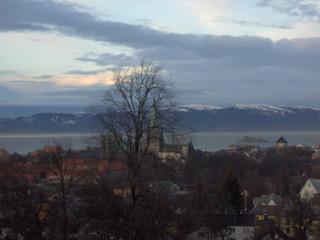
to this

to this
The only reason I moved was that now I have my own office space rather than sharing it with 3 others.
Tuesday, July 26, 2005
Why QWERTY keyboard?
I had always wondered, but never discovered until today why the keyboard is laid out in this wierd way. It appears that this keyboard layout was designed by Scholes so as to slow typing speed. The initial model has a mechanical problem caused by people typing fast and hence the keybaord was laid out in such a way that our fingers would have to travel maximum distance.
Isn't it stupid that computers use the same layout when no such mechanical problems canever exist?
Read more about this at How Stuff Works and Wikipedia.
Isn't it stupid that computers use the same layout when no such mechanical problems canever exist?
Read more about this at How Stuff Works and Wikipedia.
Quick note on earlier post
I wanted to add that my last post was a piece I wrote nearly 8 years ago for my now-defunct personal webpage. I put it up here again, as it may serve as background on a post that refuses to see daylight.
Monday, July 25, 2005
Colour symbolism in Hindu culture
Pootu vaitha oru vatta nila...
So goes a song from the movie tamil Idhayam. Roughly translated it is "A round moon with a bindhi". Tamil poets from the days of yore (this one by poet Vairamuthu),have tried to descibe the beauty of a tamil woman. A few constants in their descriptions -long hair decked with flowers, chandramukhi (woman with a face like the moon) and a pottu (bindi) smack in the middle of her forehead.
Yes, the pottu adds greatly to a woman's beauty, but why the red pottu and in that specific location? The red color and the location can be prefuncturily explained based on aesthetics. Red is a beautiful and bright color that contrasts well with the fair skinned aryan woman and symmetry requires the location specified earlier.
Is that all there is to it? Well , I think not. A key aspect of Hindu culture (I am specifically referring it to as culture rather than religion as I believe we muddled the two later on) is its symbolism. So here is my take on it......
The pottu is mainly red in color. Red color has the longest wavelength and can thus be seen the farthest (that is why the stop light is red!!!). Red also symbolizes fire... the fire of passion. When a girl is young, she wears the pottu to signify the passion in her. The question that could come up here is - Doesn't a man have passion? He certainly does, but our (rather our ancestor's) society, being as it was, allowed men to lay bare their passion - for education, women etc.
When the woman is married, she applies it to the top of her forehead where the hair starts. This is to indicate that her love is consummated or satisfied. It is a sort of warning sign to all other men who look at her. Also in some cultures, the woman cover her hair after her wedding. This is because the hair is black and black signifies that it accepts everything/everyone.
The color symbolism is so important in our culture. Another such symbolism is why widows wear white and their hair shorn. White as a color repels all light/colors. When a woman is clothed in white, she tells the wold that she is no longer an active participant..... I repel all of you.. all I have is within me.
Women these days barely wear the pottu. They ignore it as having religious connotations, which do not go well in this liberal, modern and hence civilized (so they say) world. Even the few who wear it, prefer black to red.
This is just one example of a religious symbol having no religious roots, rather a societal or cultural root. There are many more such examples. I wish people would stop to ask or think, why we (or our parents) do certain things the way we (or they) do and try to come up with rational explanations rather than accepting them on blind faith or rejecting them as being religious.
We don't give our ancestor's enough credit for being rational thinkers!!
Point of view
I came across this quote attributed to the great German mathematician David Hilbert:
Some people have got a mental horizon of radius zero and call it their point of view.Liked it!!
Saturday, July 23, 2005
Friday, July 22, 2005
Dehyphenation of India-Pakistan
As a rule, I decided I would not write anything about India-Pakistan relations in my blog as I have a few very good friends from Pakistan and do not want to write anything that can be construed as being deprecating. But I could not help myself from writing this.
While most (if not all) analysis on PM Manmohan Singh's visit say that the biggest gain for India from the trip was the dehyphenation of India and Pakistan for American policy makers, I can only muse why it took so long. The hyphenation, thanks to the British (with a lot of help from Nehru, Jinnah, Gandhiji and the others), was natural as long as the hyphenation existed between the two superpowers after WWII USA-USSR, with India leaning towards USSR and Pakistan towards USA. I said it was natural, but I am wrong. Hyphenation, I believe, can exist only between countries of equal size or capability, if you will. But suprisingly, India-Pakistan hyphenation existed even long after USSR disintegrated and Russia did not posses the stature any more to be hyphenated with the US of A. India, in turn, cannot and should not hope to be hyphenated with China, a country that is way ahead of India in all spheres (except democracy some maay point out).
That said, I think the hyphenation makes sense in another context. Pakistan and India, particularly the North of India, have a lot in common. At the time of the partition, Muslims in the north of India, mainly the Hindi/Urdu speaking, moved over to Pakistan while the Bengali speaking Muslims moved to Bangladesh (or then East Pakistan). The south of India was thankfully kept out of it. But I am digressing here.
Thus the hyphenation makes sense - similar people having different coloured passports thanks to an imaginary line, a line that not everyone were (or are) happy with. In some ways this hyphenation represents that imaginary line. But then why not India-Bangladesh? Well the Bangladesh are not Hindi?Urdu speaking, are they? India, unfortunately is historically Hindi centric. No, there is no typo there... it is Hindi-centric - not Hindu-centric. Ok let me leave this at that.
But then, what really helped get rid of this hyphenation? It is not very difficult to see. India, the 4th largest economy in the world, has gone from being India - a land of snake charmers, to India - a land of IT experts, outsourcing capital of the world, a land that exports experts. Unfortunately, Pakistan has come to represent what can go wrong when democracy fails. It has become, particularly these past few weeks, as a land that exports Islamic terrorists and ideologies.
It is really unfortunate that our countries should have taken these disparate routes - but India, could have potentially gone the same route, if not for its diversity.
While most (if not all) analysis on PM Manmohan Singh's visit say that the biggest gain for India from the trip was the dehyphenation of India and Pakistan for American policy makers, I can only muse why it took so long. The hyphenation, thanks to the British (with a lot of help from Nehru, Jinnah, Gandhiji and the others), was natural as long as the hyphenation existed between the two superpowers after WWII USA-USSR, with India leaning towards USSR and Pakistan towards USA. I said it was natural, but I am wrong. Hyphenation, I believe, can exist only between countries of equal size or capability, if you will. But suprisingly, India-Pakistan hyphenation existed even long after USSR disintegrated and Russia did not posses the stature any more to be hyphenated with the US of A. India, in turn, cannot and should not hope to be hyphenated with China, a country that is way ahead of India in all spheres (except democracy some maay point out).
That said, I think the hyphenation makes sense in another context. Pakistan and India, particularly the North of India, have a lot in common. At the time of the partition, Muslims in the north of India, mainly the Hindi/Urdu speaking, moved over to Pakistan while the Bengali speaking Muslims moved to Bangladesh (or then East Pakistan). The south of India was thankfully kept out of it. But I am digressing here.
Thus the hyphenation makes sense - similar people having different coloured passports thanks to an imaginary line, a line that not everyone were (or are) happy with. In some ways this hyphenation represents that imaginary line. But then why not India-Bangladesh? Well the Bangladesh are not Hindi?Urdu speaking, are they? India, unfortunately is historically Hindi centric. No, there is no typo there... it is Hindi-centric - not Hindu-centric. Ok let me leave this at that.
But then, what really helped get rid of this hyphenation? It is not very difficult to see. India, the 4th largest economy in the world, has gone from being India - a land of snake charmers, to India - a land of IT experts, outsourcing capital of the world, a land that exports experts. Unfortunately, Pakistan has come to represent what can go wrong when democracy fails. It has become, particularly these past few weeks, as a land that exports Islamic terrorists and ideologies.
It is really unfortunate that our countries should have taken these disparate routes - but India, could have potentially gone the same route, if not for its diversity.
Monday, July 18, 2005
Kuttime enters world...
Arthi and self became proud parents of a baby girl today. She was born at 4:57 IST at Mehta Hospital in Chennai.
More later....
More later....
Wednesday, July 13, 2005
Bush Vs The Godfather
Don Corleone valued one thing most - loyalty to friends and so does the President of the United States - NY Times has this line in an article in todays paper on the Karl Rove case
Go figure!!!!
They point to the words Mr. Bush used to silence conservative critics of Attorney General Alberto R. Gonzales last week, warning them curtly, "I'm loyal to my friends."The Don stuck to his principles and faith and refused to go against it and so does President Bush. The biggest difference between these two characters (one fictional and the other not - unfortunately) is that the Don was prepared to accept his mistakes and that made him a better person.
Go figure!!!!
Wednesday, July 06, 2005
A New Kind of Science (or NKS as the Wolfram guys say)
I bought the NKS book within a couple of weeks of its release in 2002. I started reading it then but got put off by the Preface and Introductory chapter in the book where I could not digest the huge dose of Wolfram's ego we were subjected to. That and work pressures meant that the book was subjected to dust in a corner of my bookshelf.
I started reading the book Sunday. A couple of things have changed that prompted me to read this book. A hot sunday eve in Trondheim, without a book to read can be pretty depressing - particularly when you are tired after a long cyle ride. I just finished reading Castle of Crossed Destinies by Italo Calvino and needed a book to read. It was a choice between Godel, Escher, Bach and NKS.
My reasearch requires me to think out-of-the-box as the field I am working is a work in progress for over 30 years now with no definite end in sight. Thus a new approach would definitely do me good and I thought NKS may be called for.
I have thus far read 100 out of the 1200 pages of the book (which could have been considerably reduced if the Is in the book were omitted). I realize that Wolfram has ignored work of other researchers in the field, or has appropriated their results as his own. The book nevertheless gives a good background and explains the field very well and thus provides a good summary. The whole area of cellular automata is interesting and the book is a good and interesting read.
All said, I think the book's title overreaches in calling it a New Kind of Science.
I started reading the book Sunday. A couple of things have changed that prompted me to read this book. A hot sunday eve in Trondheim, without a book to read can be pretty depressing - particularly when you are tired after a long cyle ride. I just finished reading Castle of Crossed Destinies by Italo Calvino and needed a book to read. It was a choice between Godel, Escher, Bach and NKS.
My reasearch requires me to think out-of-the-box as the field I am working is a work in progress for over 30 years now with no definite end in sight. Thus a new approach would definitely do me good and I thought NKS may be called for.
I have thus far read 100 out of the 1200 pages of the book (which could have been considerably reduced if the Is in the book were omitted). I realize that Wolfram has ignored work of other researchers in the field, or has appropriated their results as his own. The book nevertheless gives a good background and explains the field very well and thus provides a good summary. The whole area of cellular automata is interesting and the book is a good and interesting read.
All said, I think the book's title overreaches in calling it a New Kind of Science.
Tuesday, June 28, 2005
What's in a name???
It is that time now, where Arthi and self have been keeping our eyes and ears open for suitable names for Kuttime. We read an article and see "....... Tarun ...... " - yes, thats right!! only the name Tarun stands out.
Choosing a name is not so straight forward. Thanks to this small thing called numerology, we have to not just pull out one name out of the hat for each sex... but a slew of them to ensure atleast one fits the bill (or number, if you will).
There are also a couple of other things on the back of our minds. Fresh out of reading Jumpa Lahiri's "The Namesake" a couple of months ago, we are wary of choosing a name that kuttime will be ashamed to be called by for the rest of her life. Hence, the search for nice and practical names is high on the list of priorities.
My first name is great. Never had problems with it, mainly because most people around New York metropolitan area, with its huge hispanic population, thought it was Raul (rather than Rahul) and now here in Europe they still think it is Raul - like the Spanish/Real Madrid striker!!! Now, my last name is another matter. My second day in the US I was referred to as Anan..blah..blah..blah - by the Manager of the International Student Services and a woman of Indian origin!!!!!
I must thank my lucky stars that my Grandpa, when he made my passport forgot my actual first name and made my passport out with my "home" name - Rahul. My actual first name is Ramakrishnan!!! If my official name was Ramakrishnan Anantharaman.. forget it.. we won't even go there!!!
I have flirted with the idea of changing my official name to Rahul A. Raman as it is compulsary in our family to have a name with Rama shabda (hence the Ramakrishnans and Anantharamans). Never got around to doing it as it would be more pain to change everything. But, I made a decision then to name my child So-and-so R. Raman.
It is amazing then that I came across this absolutely hilarious post on South Indian names through Amit Varma's IndiaUncut. I present a sampling of the post but urge you to read the complete post at http://sidin.blogspot.com/2004/05/travails-of-single-south-indian-men-of.html . It is a must read and one of the funniest pieces I have ever come across.
And what's in a name you ask.........
Choosing a name is not so straight forward. Thanks to this small thing called numerology, we have to not just pull out one name out of the hat for each sex... but a slew of them to ensure atleast one fits the bill (or number, if you will).
There are also a couple of other things on the back of our minds. Fresh out of reading Jumpa Lahiri's "The Namesake" a couple of months ago, we are wary of choosing a name that kuttime will be ashamed to be called by for the rest of her life. Hence, the search for nice and practical names is high on the list of priorities.
My first name is great. Never had problems with it, mainly because most people around New York metropolitan area, with its huge hispanic population, thought it was Raul (rather than Rahul) and now here in Europe they still think it is Raul - like the Spanish/Real Madrid striker!!! Now, my last name is another matter. My second day in the US I was referred to as Anan..blah..blah..blah - by the Manager of the International Student Services and a woman of Indian origin!!!!!
I must thank my lucky stars that my Grandpa, when he made my passport forgot my actual first name and made my passport out with my "home" name - Rahul. My actual first name is Ramakrishnan!!! If my official name was Ramakrishnan Anantharaman.. forget it.. we won't even go there!!!
I have flirted with the idea of changing my official name to Rahul A. Raman as it is compulsary in our family to have a name with Rama shabda (hence the Ramakrishnans and Anantharamans). Never got around to doing it as it would be more pain to change everything. But, I made a decision then to name my child So-and-so R. Raman.
It is amazing then that I came across this absolutely hilarious post on South Indian names through Amit Varma's IndiaUncut. I present a sampling of the post but urge you to read the complete post at http://sidin.blogspot.com/2004/05/travails-of-single-south-indian-men-of.html . It is a must read and one of the funniest pieces I have ever come across.
"Our futures are shot to hell as soon as our parents bestow
upon us names that are anything but alluring. I cannot imagine a more foolproof way of making sure the child remains single till classified advertisements or that maternal uncle in San Francisco thinks otherwise. Name him "Parthasarathy Venkatachalapthy" and his inherent capability to combat celibacy is obliterated before he could even talk. He will grow to be known as Partha. Before he knows, his smart, seductively named northy classmates start calling him Paratha. No woman in their right minds will go anyway near poor Parthasarathy. His investment banking job doesn't help either. His employer loves him though. He has no personal life you see. By this time the Sanjay Singhs and Bobby Khans from his class have small businesses of their own and spend 60% of their lives in discos and pubs. The remaining 40% is spent coochicooing with leather and denim clad muses in their penthouse flats on Nepean Sea Road. Business is safely in the hands of the Mallu manager. After all with a name like Blossom Babykutty he cant use his 30000 salary anywhere. Blossom gave up on society when in school they automatically enrolled him for Cookery Classes. Along with all the girls.
Yes my dear reader, nomenclature is the first nail in a coffin of neglect and hormonal pandemonium. In a kinder world they would just name the poor southern male child and throw him off the balcony. "Yes appa we have named him Goundamani..." THUD. Life would have been less kinder to him anyway."
And what's in a name you ask.........
Subscribe to:
Posts (Atom)