Tuesday, June 28, 2005

What's in a name???

It is that time now, where Arthi and self have been keeping our eyes and ears open for suitable names for Kuttime. We read an article and see "....... Tarun ...... " - yes, thats right!! only the name Tarun stands out.

Choosing a name is not so straight forward. Thanks to this small thing called numerology, we have to not just pull out one name out of the hat for each sex... but a slew of them to ensure atleast one fits the bill (or number, if you will).

There are also a couple of other things on the back of our minds. Fresh out of reading Jumpa Lahiri's "The Namesake" a couple of months ago, we are wary of choosing a name that kuttime will be ashamed to be called by for the rest of her life. Hence, the search for nice and practical names is high on the list of priorities.

My first name is great. Never had problems with it, mainly because most people around New York metropolitan area, with its huge hispanic population, thought it was Raul (rather than Rahul) and now here in Europe they still think it is Raul - like the Spanish/Real Madrid striker!!! Now, my last name is another matter. My second day in the US I was referred to as Anan..blah..blah..blah - by the Manager of the International Student Services and a woman of Indian origin!!!!!

I must thank my lucky stars that my Grandpa, when he made my passport forgot my actual first name and made my passport out with my "home" name - Rahul. My actual first name is Ramakrishnan!!! If my official name was Ramakrishnan Anantharaman.. forget it.. we won't even go there!!!

I have flirted with the idea of changing my official name to Rahul A. Raman as it is compulsary in our family to have a name with Rama shabda (hence the Ramakrishnans and Anantharamans). Never got around to doing it as it would be more pain to change everything. But, I made a decision then to name my child So-and-so R. Raman.

It is amazing then that I came across this absolutely hilarious post on South Indian names through Amit Varma's IndiaUncut. I present a sampling of the post but urge you to read the complete post at http://sidin.blogspot.com/2004/05/travails-of-single-south-indian-men-of.html . It is a must read and one of the funniest pieces I have ever come across.

"Our futures are shot to hell as soon as our parents bestow
upon us names that are anything but alluring. I cannot imagine a more foolproof way of making sure the child remains single till classified advertisements or that maternal uncle in San Francisco thinks otherwise. Name him "Parthasarathy Venkatachalapthy" and his inherent capability to combat celibacy is obliterated before he could even talk. He will grow to be known as Partha. Before he knows, his smart, seductively named northy classmates start calling him Paratha. No woman in their right minds will go anyway near poor Parthasarathy. His investment banking job doesn't help either. His employer loves him though. He has no personal life you see. By this time the Sanjay Singhs and Bobby Khans from his class have small businesses of their own and spend 60% of their lives in discos and pubs. The remaining 40% is spent coochicooing with leather and denim clad muses in their penthouse flats on Nepean Sea Road. Business is safely in the hands of the Mallu manager. After all with a name like Blossom Babykutty he cant use his 30000 salary anywhere. Blossom gave up on society when in school they automatically enrolled him for Cookery Classes. Along with all the girls.

Yes my dear reader, nomenclature is the first nail in a coffin of neglect and hormonal pandemonium. In a kinder world they would just name the poor southern male child and throw him off the balcony. "Yes appa we have named him Goundamani..." THUD. Life would have been less kinder to him anyway."


And what's in a name you ask.........

Thursday, June 16, 2005

Arthi's Vallaikappu

Vallaikappu is baby shower in western speak. Vallaikappu is a combination of two words - vallai - meaning round (as in bangle) and kappu - meaning protection. This is a ceremony performed in South India during the 7th month of pregnancy for women.

The pregnant woman is made to wear many glass bangles - an odd number on one hand and an even number on the other - in addition to a set of gold and silver bangles. She is given many gifts and after this function the pregnant woman goes to her mother's place for childbirth.

The emotional part of the child's brain is said to be developed in the 7th month. As the mother recieves gifts and is adorned in bangles - she is happy and this happiness is transferred to the baby. Further, as this is the time the baby can also hear clearly, the sound from the clanging of the glass bangles amuses the baby.

Arthi's vallaikappu took place on the 10th of June at her parent's home in Chennai. A few photos of the function can be seen at
http://photos.yahoo.com/arthivraman

A little bit about bangles from an article in the Hindu titled Epitome of Feminine Grace to end this blog.

Bangles, the decorative ornaments of women, have over the centuries acquired a socio-cultural-religious significance. Literature through the ages has glorified this ornament and made it the epitome of feminine grace.

The ornament was purely a decorative accessory in the pre-Vedic era and even in the post-Vedic times until the medieval period. Medieval India gave Hinduism a chauvinistic twist distorting Vedic concepts and introduced ritualistic beliefs. It was at this stage that the bangle was transformed from a mere decoration to a symbol of marriage. The bangle thus began to gain social significance and ritualistic relevance.

Sarojini Naidu extols them as ''The rainbow tainted circles of light lustrous tokens of radiant light'. 'Truly, bangles' circles of light are an inseparable part of Indian woman without which she is incomplete. From a suckling to the grey-haired they lend an inexplicable charm and dignity. They are as varied as the womanfolk itself in their appeal and beauty. The tender feminine grace acquires an additional sheen with them. They are as old as the Vedas. Whatever the impact of changing times and fashions, bangles continue to have their undiminished sway particularly in the celebration of any occasion from a simple birthday to a grand marriage.

Bangles also have traditional value. Hindu married women always wear some bangles round both their wrists as it is considered inauspicious to be bare armed.Kameswari, an architect, says that bangles do not play a role in her daily attire, but likes to wear them on occasions and festivals as bangles have sentimental value.

A teacher from Central School, R. Nagamani, says bangles are like a shadow to substance for a Hindu woman. A woman is incomplete without bangles. They are not just ornaments but a part of womanhood and honour.

.....

Bangles are not mere jewellery but an expression of feminity and is beyond class, creed and culture.

Friday, June 03, 2005

Western Europe under spotlight

Western Europe, or rather the social structure of western Europe is under spotlight after the French and the Dutch overwhelmingly rejected the EU constitution in separate referendums. It is worthwhile to nte that both these countries are two of the 6 founding members!!!

The constitution was rejected in both these countries for different reasons, but it is the Frech No vote that has come under most scrutiny. Whatever the rationale the French people may have had for voting No, I am sure the criticism of the social structure they hold so dear did not figure in the mix.

An Op-ed column in the NY Times by Davik Brooks quite succintly points out what the problem is. I qoute Brooks below:

"The core fact is that the European model is foundering under the fact that billions of people are willing to work harder than Europeans are. Europeans clearly love their way of life, but don't know how to sustain it.

Over the last few decades, American liberals have lauded the German model or the Swedish model or the European model. But these models are not flexible enough for the modern world. They encourage people to cling fiercely to entitlements their nations cannot afford. And far from breeding a confident, progressive outlook, they breed a reactionary fear of the future that comes in left- and right-wing varieties - a defensiveness, a tendency to lash out ferociously at anybody who proposes fundamental reform or at any group, like immigrants, that laters the fabric of life.

This is the chief problem of the welfare state, which has nothing to do with the success or efficiency of any individual program. The liberal project of the postwar era has bred a stultifying conservatism, a fear of dynamic flexibility, a greater concern for gaurding what exists than for creating waht doesn't"

I might add that Brooks is an American conservative.

The French really want to stick to their 35 hour week. Last year, a book by a employee in Franc'e state owned electric company, EDF, wrote a book on how to spend the entire day ( 7 hrs) without working and cheat you boos. This book was a bestseller there!!!! These people have problems.

Having lived in both the US and Europe, I really do notice the difference. The quality of life in Europe is much much better and I certainly do lead a fuller life here. Yes, American society is certainly more dynamic - but there are loads of problems associated with it.

In short - no system works perfectly. Is it possible to find a good balance between the European model and the American one? The Canadian model is a model with such a compromise - with its own share of problems.

Monday, May 30, 2005

Coincidence?

After reading My Name is Red where miniaturists decry Venitian style painting, I read Tales of Protection where there is a story in which a painter explains in painstaking detail on how to paint Venetian style.

Coincidence? An underlying force that drove me to read Tales of Protection after My Name is Red?

I actually bought My Name is Red when I had to while away time at Oslo - I had already bought Tales of Protection by then.... I was waiting to finish Namesake (by Jhumpa Lahiri) before I started reading Tales of Protection. I instead ended up reading My Name is Red first!!!!

Recent reads... My Name is Red

Before Tales of Protection, I read My Name is Red by Turkish author Orhan Pamuk. Another great book from an author who many people believe will be a Nobel laurate one day.

The book is set in the late 16th century in Istanbul and is a story where all the major players are miniaturists (artists who paint miniature style). The book is a murder mystery - one of the minaturists is killed in the first chapter of the book and the rest of the book tries to get the reader to identify who the murderer is - in its own unique style. The story is told in different people's (or things) viewpoint - with the chapter heading like "I am a corpse" or "I am a dog speaking" giving you an idea as to who's viewpoint it is.

The book is to miniature painiting what Dr Faustus (by Thomas Mann) is to western classical music. Through the story you are explained the various intricacies of the miniature painting, the idea of style or the lack of it and their hatred for western stylle painting (they call it Venetian style here) where people are potrayed as is!!!

Readers who enjoyed Name of the Rose (by Umberto Eco) will certainly dig this one. This is much better than the Name of the Rose.

My recent reads - Tales of Protection

I just finished Tales of Protection by Norwegian author Erik Fosnes Hansen. An amazing, amazing book. The idea of the story (or stories) is original and he writes with a flair that is precise.

The novel is based on a fascination in the parallels between seemingly disparate lives. A Norwegian billionare collects and researches coincidences in the world. Based on such coincidences he proposes the existence of some profound something - something that has not been found or recognized as yet. How does a collection of seemingly random events always end up following a mathematical pattern - a coin toss for example??? He dies and leaves his grand niece with all his collected research.

3 'stories' follow the initial the initial contemplation of these questions. There are some elements and coincidences linking these 3 different stories - first of a Swedish lighhouse keeper, a Renaissance nobleman and his servant Fiorello and finally a story from the past of the millionare himself around the time of the second world war.

The book is certainly not a fast read and must be read with concentration. More than reading, I think I spent more time on reflection. The book is profound. I would love to go back and re-read this one again. See if I look at things differently.

Oh.. and by the way - for me that something which has not been found or recognized as yet.. is my idea of GOD - the unexplained force!!!

Read the book!!! Not recommended for those who like to read pacy novels like the Da Vinci Code.

Tuesday, May 24, 2005

Sworn off cabs.... now what - reptiles?

Having sworn off cabs, I decided to hike to explore Taormina and the beaches around it on the 18th. Taormina is 8-9 kms from Naxos Beach Resort and is not a long walk at all. My advisor (a long distane runner) ran upto Taormina each day here was there and gave me directions for the walk. The only tricky part, he said, was the hike up the mountain along ungravlled paths. I assured him, and my colleague, that I could easily walk 8 kms and walking up a hill was certainly not a problem.

After breakfast, properly clothed in a pair of shorts and a T-shirt I began my walk to Taormina. After 5 kms I hit the trail going up the hill. The first few minutes were fine, until I hit the bushes and saw... What was that? A snake? I saw it again - it was like a lizard - coloured green and red. It moved like lighting. (Something like an Aranai, as we call it in Tamil).

Those of you who know me well can predict what happened!!! I did not wait to think. I ran up the hill as fast as my legs could take me. By the time I reached the top, I was out of breath, completely drenced and had dropped my bottle of water somewhere along the way. I crawled my way to the nearest shop and bought myself water and chilled out for nearly half an hour.

On my way back down, what do you think I would have preferred? Taking the cab back down or brave the walk?

I WALKED!!! Rather, I ran down the hill in 5 mins flat - figured my chances were better with the reptiles than in a cab!!!!!

What is equivalent to riding a roller coster but only more dangerous?

Sitting in the front seat of a taxi in Italy, or Taormina to be more precise.

A colleague of mine, my advisor, a professor from Mexico and myself went up to Taormina from Giardini di Naxos for dinner on the 16th of May during our conference there. After a very hearty meal (and quite a few beers and a couple of bottles of wine, I might add) we hired a cab back to Naxos Beach Resort where we were staying. As soon as we were seated, the cab driver zipped off. He went at nearlt 150 km/hr on a winding road down to Naxos (Taormina is on a hill). All of us were shocked at the speed (not exactly at the speed, rather where he decided to speed). I was sitting up front and turned back to see my advisor. At that instant we all started laughing. The driver, thinking that we were having fun, went even faster!!!!

Luckily for us, we hit traffic (1 slow car in a narrow street is traffic) as we reached the bottom of the hill into Naxos. We relaxed and started talking about the conference, when suddenly we felt accelaration. I turned up front and saw that the "safety" car in front of us was no more and our friend was speeding along the backstreets of Naxos at 170 km/hr!!!!! This was when I came up with the title of this post. It certainly felt more exciting than sitting in a roller coaster - but hell it was certainly more dangerous. We were again laughing, but that was nervous laughter. All of us breathed a collective sigh of relief as we got off the cab at the hotel.

I don't think I will ever forget that moment. These guys play Need for Speed for real in their back streets. No wonder F1 is like religion there.

Forza Italia!!!!

Saturday, May 21, 2005

Coach season

This month has seen a spate of new coaches being appointed to cricket teams - Mickey Arthur for South Africa, Greg Chappell for India and most likelt Tom Moody for Sri Lanka.

A moot point is does an Indian coach have to be Indian? Mohinder Amarnath and a few others thought so... but after the success of John Wright there were many more who thought that the nationality of the coach is of no consequence. I agree. Cricket has become so competitive and professional that the goal is excellence - irrespective of where you are getting the help from.

But I believe we must move away from having national teams to just teams. The coach, in my opinion, is a very important cog in the cricket team. John Wright proved how the fortunes of the team can change when coached right. (John Bracewell is showing how bad a team can perform if it does not have the right coach) So is an Indian teach coached by a non-Indian a truly Indian team? No.. certainly not. Add to it, a South African trainer and an Australian psychologist!!!!

Cricket, I think, has started to transcend national borders in search of excellence and we must bow to it and accept teams without a nationalist connotation where players can easily move about between teams. Brett Lee, for one, would sure welcome that.

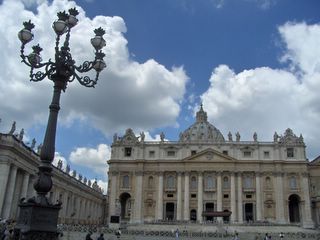
St Peters square and the Vatican

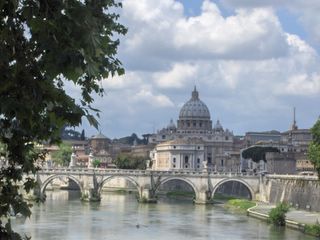
The Vatican

Vatican across river Tiber

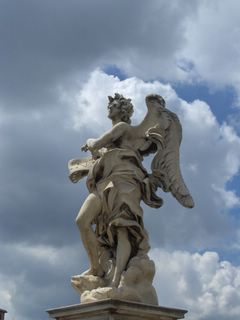
Angel on Pont Angel

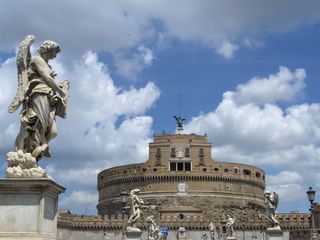
Castel Angel

Friday, May 20, 2005


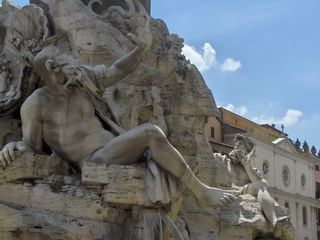
Another view of Fountain of 4 rivers

Bernini's Fountain of 4 rivers

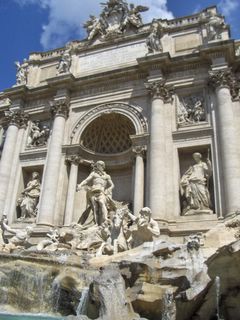
Trevi fountain - another take

The Trevi fountain

Spanish steps in Rome

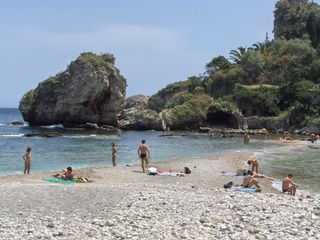
Isobella again